Editor is in read-only mode. Login to edit or copy saved pads.
Physics II
Physics II
Module 1: Electric Charges, Forces, and Fields
Electric charge is a fundamental property of matter which determines how it interacts with electromagnetic fields. There are both positive and negative charges, with the same charges repeling and opposite charges attracting.
Electric charge is quantized
SI unit of electric charge is the coulomb (C)
Elementary charge is
Proton:
Neutron:
Electron:
Law of Conservation of Charge
Charge is conserved—the net charge of the universe or a local closed environment is constant. When we speak of charges “cancelling,” we are referring to the oppositely directly forces applied cancel for a net force of zero. The charge itself does not disappear.
An electric force is created by electric charges, acting without physical contact between the two objects, but its magnitude strengthening with proximity and the amount of electric charge.
Electrostatic Repulsion: Interacting objects with same sign of charge have a repulsive force
Electrostatic Attraction: Interacting objects with opposite sign of charge have an attractive force
*Magnitude is separate from type of charge (+/-)
Coulomb's Law
If two objects have electric charge, they exert an electric force on each other. The direction of the force vector is along the imaginary line joining the two objects, dictated by signs of charges involved. Its range is infinite.
Principle of Superposition:
When there's multiple source charges, the analysis can be repeated with a test charge: another point charge that is used to test the strength of the force provided by the source charges
Force doesn't necessarily point in same direction as the unit vector—may be opposite depending upon the signs of the source/test charge
Electromagnetic forces are much stronger than gravity—every other force studied in Physics I is electromagnetic in nature, as contact is an illusion due to the repulsion of outer electrons of substances.
Electrical Properties of Materials
In an atom, electrons surround a tiny nucelus of protons and neutrons in the form of a vast cloud of negative charge. The outermost valence electrons can wander from atom to atom, driving the movement of charge. A material's properties is dependent on the strength of the valence electron bonds.
Conductor: Electric current flows freely. Loosely bound conduction electrons.
Insulator: Current doesn't flow readily. Tightly bound valence electrons.
Semi-conductors: Determined by impurities, which can change conductivity through the number of loosely bound valence electrons.
Excess charge on an insulator stays in place and result in electrical attractive and repulsive forces, while excess charge placed on a conductor will instantly flow away.
Charging by Induction
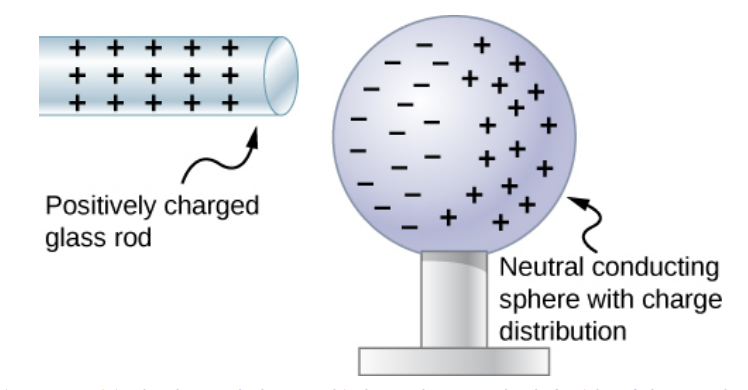
When an electrically charged object is brought close to a conductor, it exerts an electric force on the conduction electrons, which flow towards the object.
While the conductor is still neutrally charged, it now has charge distribution, forming an electric dipole through inducing polarization.
When brought near an insulator or neutral substance, the distribution of charge in atoms/molecules changes. Due to the electric force decreasing with distance, the attraction of unlike charges is stronger than the relpulsion of like charges—neutral objects can be attracted to a charged object.
Static Electricity: Rubbing two neutral objects together can displace normally stationary electrons through friction, resulting in an imbalance of charge within the object. This results in the “shock” of a rapid flow of electrons to another object when a conductive path is available to equalize the charge.
Electric Fields
A field is a physical quantity whose value depends on (is a function of) position, relative to the source. It is a way of describing how an object influences the space around it, giving a value at every point in space.
We often use vector fields, which assign a magnitude and direction to each point, making a collection of an infinite number of distinct vectors across space.
A familiar field we understand is a gravitational field, which tells us how much force a mass will feel if it is there. However, the field exists even without the mass—fields separate the source from the effect
An electric field is the effect a charge has on the space around it—how much electric force would be applied per coulomb of charge.
The electric charge on an object alters the space around it in such a way where all other electrically charged objects experience an electric force as a result of being in the field.
Executable
Display
E=qF,CN=mV
Executable
Display
E:electric field at a pointF:force on a small positive test chargeq:test charge
Follows superposition, as do forces: if multiple charges arepresent, the net electric field at a point is the vector sum.
Executable
Display
Enet=∑iEiEnet=E1+E2+E3+...
For an electric field due to a point charge,
Executable
Display
E=r2kQr^
Continuous Charge Distributions:
When a charge is spread out amongst an object, break it into tiny sections, , and add up the charges.
Executable
Display
dE=kr2dqE=k∫r2dqr^
Geometrical Charge Distributions
Executable
Display
Linear Charge Distribution: Charge per Lengthλ=LQdq=λdLArea Charge Distribution: Charge per Areaσ=AQdq=σdAVolume Charge Distribution: Charge per Volumeρ=VQdq=ρdV
The electric field shows the strength and direction of the electric force a positive test charge would feel at any point in space. By convention, all electric fields point away from positive source charges and toward negative charges.
Electric Field Lines / Diagrams
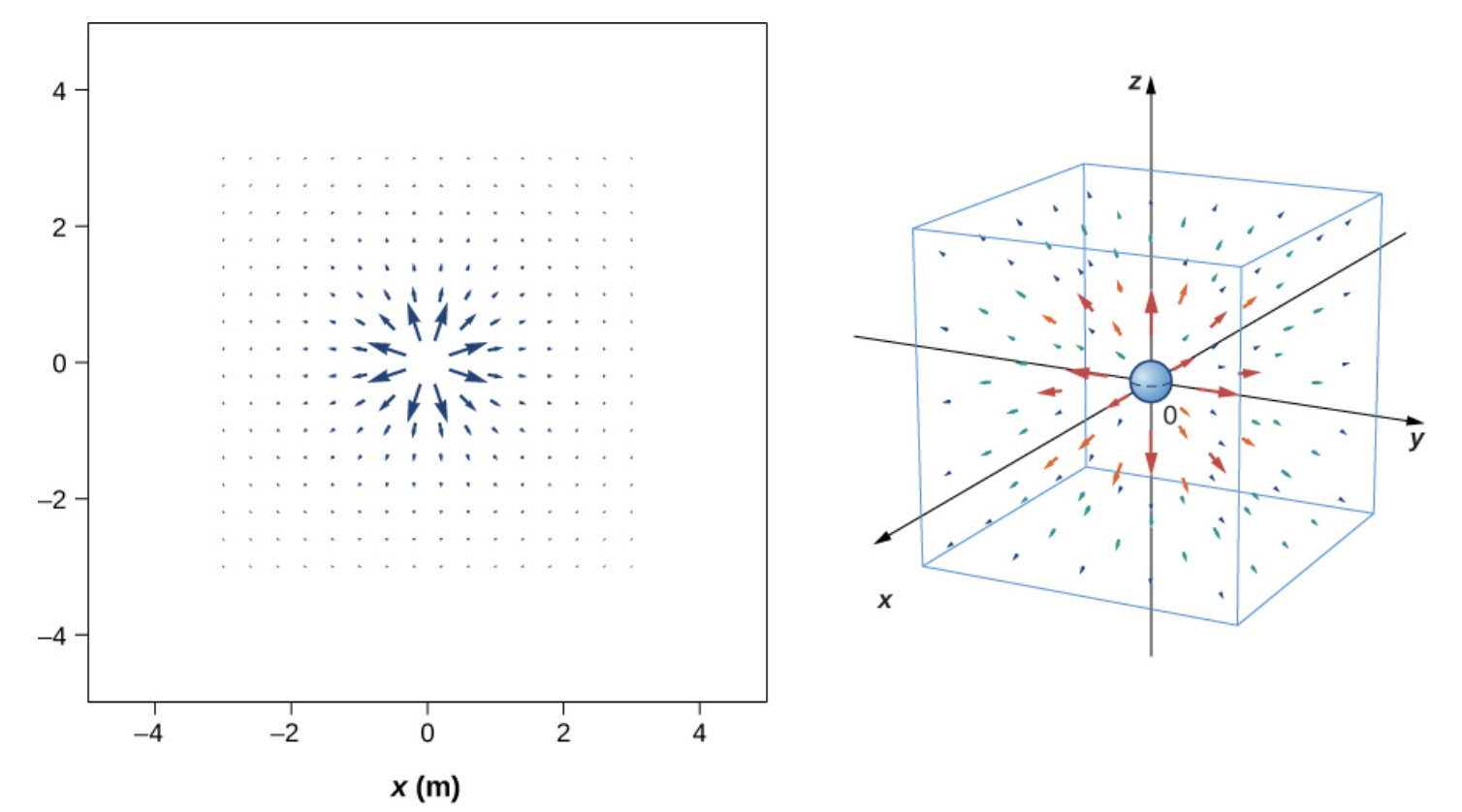
Allows a visualization of how the space is altered through geometrical sketches. Each arrow is a representation of the field vector at a point.
Vector Diagram
Magnitude: corresponds with length
Direction: radially away from source charge
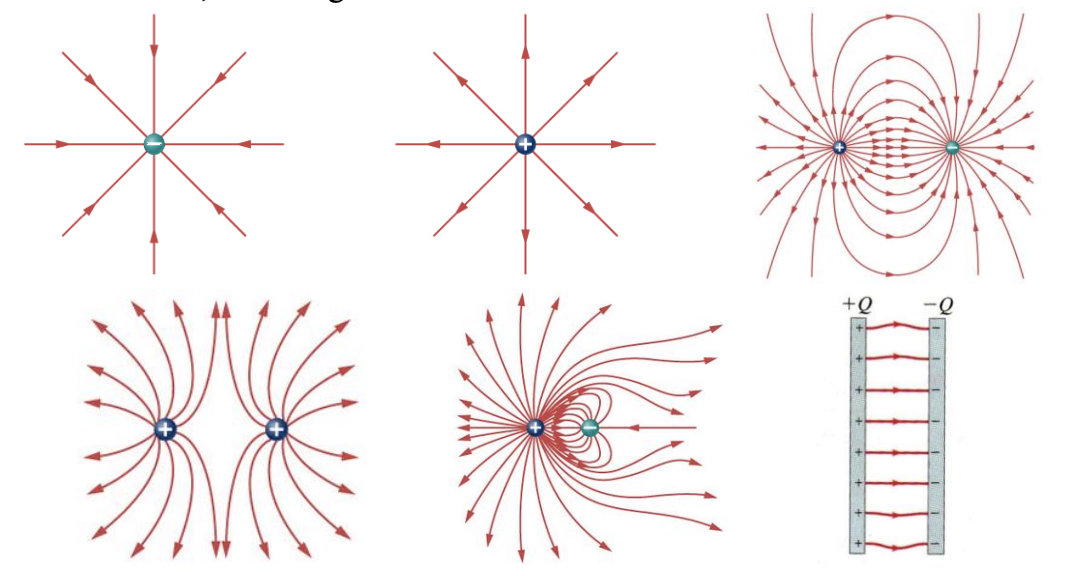
Field Line Diagram
Direction: direction of field vector at point—field vectors are tangent to field lines
Magnitude/Strength: indicated by field line density, number of field lines per unit area
Drawing Field Line Diagrams:
Field lines originate on positive charges and terminate on negative charges. Number of field lines originating/terminating from a charge is proportional to charge magnitude.
In isolated charges, lines go to or from infinity.
Field lines can never cross—an electric field cannot point in two directions at a single point.
Lines are perpendicular to conductor surfaces.
Module 2: Gauss's Law
Electric Flux
The concept of flux describes how much of something goes through a given area—the dot product of a vector field with an area.
Electric flux is a measure of the number of electric field lines passing through an area. For uniform electric field through a flat area, it is the scalar product of the electric field and area vector.
In general, when field lines flow out of a closed surface, φ is positive, and when they flow into a surface, φ is negative.
For a non-flat surface, it can be divided into an infinitesimal small flat flux elements, finding the net flux by summing up each individual flux element (integration across the non-flat surface).
Executable
Display
ΦE=E⋅A=EAcosθΦE=∫SE⋅dAΦE=∮SE⋅dA*Circle represents that surface isclosed and integration is happeningover entire surface. A portion of aclosed surface is treated as an opensurface subset
An area vector of a flat surface has a magnitude equal to area, , and a direction that is normal (perpendicular) to the surface. For an open surface, any direction can be used as long as it is consistent. If a surface is closed, then the vector points from the inside to the outside.
Gauss's Law
If a closed surface does not have any charge inside of it where an electric field can terminate, then the electric flux through the surface is zero. However, if there is charge inside the enclosed volume, this vlue is equal to the total charge enclosed divided by the permittivity of free space constant.
Executable
Display
Φ=∮SE⋅dA=ε0Qenc
If has the same magnitude everywhere on the Gaussian surface and is parallel to the outward normal, then
Executable
Display
∮EdA=E∮dA=EA
*Permittivity of free space/vacuum constant:
Module 3: Electric Potential
Electric Potential Energy:
Executable
Display
ΔV=qΔPE=q−W=q−F⋅d=−E⋅d
The Electron-Volt
The energy given to a fundamental charge accelerated through a potential difference of 1 V.
Equations and Concepts Reference
ELECTRICITY
Charges and Constants
Elementary Charge:
Coulomb's Constant:
Vacuum Permittivity:
Charge Distribution
Linear:
Surface (Area): or
Volume: or
Electric Fields
The effect a charge has on the space around it: the strength and direction a positive test charge would experience. Points toward negative electric charges.
Executable
Display
E=kr2∣Q∣E=qFE=∑Ei
Electric Forces
Coulomb's Law determines the magnitude between two point charges. Direction is determined by the charge signs—opposites attract.
Executable
Display
F=kr2q1q2orF=kr2q1q2r^
Electric Flux
The amount of electric field lines going through an area. An area vector is normal to the surface, = A.
Executable
Display
Φ=E⋅A=EAcosθΦ=∮SE⋅dA=ε0Qenc
The integral often simplifies and isn't needed:
Point charge with uniformly charged sphere
Spherical shell—thick uses
Infinite line charge or plane, between plates
Electric Potential
The stored energy due to the position of charges per unit charge at a point.
Scalar—the sign of Q is included. Add algebraically.
Executable
Display
V=krQV=k∑riQi
points in the direction of decreasing potential.
Executable
Display
ΔV=−∫E⋅dlΔV=−E⋅dE=−∇V⇒Ex=−dxdV,etc..
Conductors and Insulators
In electrostatic equilibrium, excess charge in a conductor object resides on the outside.
inside
outside = point charge at the center.
For an insulator, the charge can be distributed throughout the volume or surface—charge distrubutions are used and integrated unless high symmetry allows for Gauss's Law to be used.
Work and Energy
Potential Energy:
Work:
Acceleration: Positive to lower V, Negative to higher V
*Forces and fields both follow superposition—the net value is the vector sum.